
Many people misunderstand: they think water is used to "wash" chips or generate power.
The truth: Water is used to absorb heat.
Data centers mainly cool servers in two ways:
Evaporative Cooling (The Water Hog)
Water sprays on hot pipes; evaporation carries heat away.
Extremely efficient, but water evaporates into the air.
Dry regions especially rely on this method.
Circulating Water Cooling
Water cycles through pipes, carrying heat to cooling towers.
Some evaporates, some recirculates.
More water-efficient than evaporation, but equipment costs more.
The Key Problem: Where Does the Evaporated Water Go?
It enters the atmosphere, may fall as rain somewhere, but not locally—this is a massive burden for water-scarce regions.
Why Is This Only Being Discovered Now?
Because you can't see it.
You use electricity, the meter spins. You use water, the meter runs. But when you tap your phone, no "water bill" pops up.
This "invisible consumption" is called the "virtual water footprint"—like when you buy a T-shirt, you're actually consuming the water used to grow the cotton and run the dye factory, but you only see the price tag.
The virtual water footprint of digital services was long ignored until data centers started "competing for water," sparking recent attention.
The Paradox: The Smarter, the Thirstier?
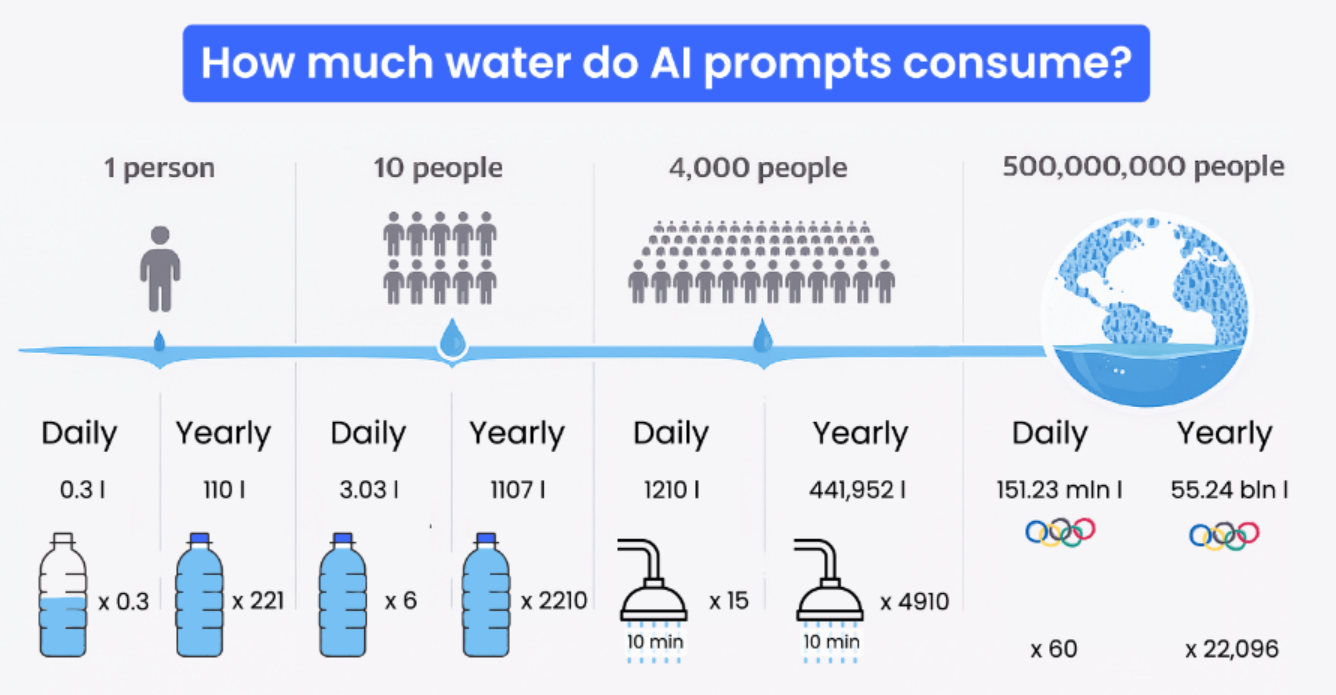
Ironically, as AI advances, water per search is actually decreasing.
Why?
New chips use less power and generate less heat.
Liquid cooling technology matures, improving water efficiency.
Data centers are migrating to cold regions (like Northern Europe, or caves in Guizhou).
But total consumption keeps soaring—because usage frequency is exploding. Water-saving technology can't keep up with the exponential growth in search volume.
What Can We Do?
Individual Level:
Reduce unnecessary searches (don't Google "what day is it today").
Turn off unused cloud service syncing.
Reduce video streaming quality (video uses 10-100x more water than text).
Industry Level:
Data centers using recycled water (Microsoft uses wastewater for cooling in Arizona).
Build near coasts, use seawater cooling (corrosion issues need solving).
Use waste heat to warm nearby communities (killing two birds with one stone).
Policy Level:
Include data center water consumption in environmental impact assessments.
Restrict high water-use data centers in water-scarce regions.
Promote "water footprint" certification, making it as transparent as carbon footprint.
Conclusion: The Real Cost of the Digital World
Every click calls upon physical resources from afar—electricity, metals, rare earths, and water.
We enjoy the convenience of "free" searches, but there's no free lunch in the world, only invisible bills.
Understanding this isn't about abandoning technology, but reminding us: convenience has a cost, and conservation is a responsibility.
Before your next search, perhaps think twice: Do I really need to look this up?